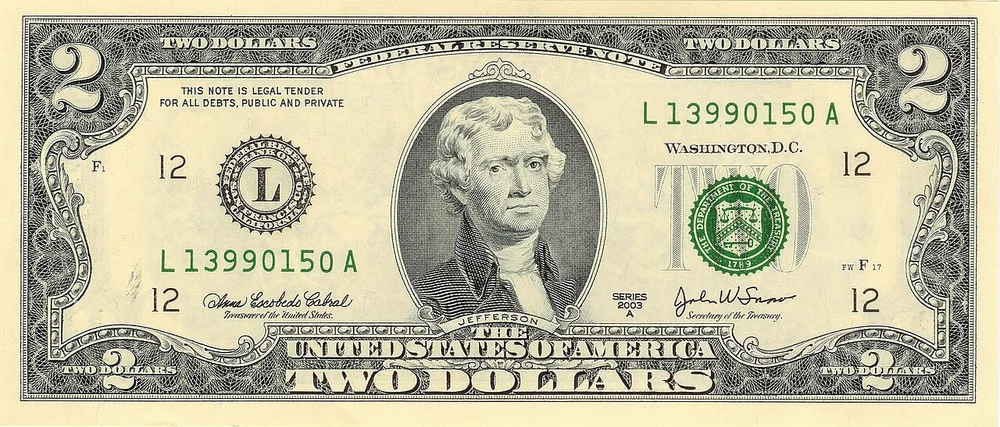
Identify the kind of $2 bill first
Look at the heading and the Treasury seal on the face of the note. Common red-seal small-size examples say United States Note and come from series such as 1928, 1953 and 1963. The 1976 Federal Reserve Note has a green Treasury seal, with the Declaration of Independence scene on the reverse. On the front of the note, find Series and record any letter after the year. That suffix is part of the issue identification.
Decide which comparison fits your note
A red-seal 1953A and a green-seal 1976 can both have Thomas Jefferson's portrait. The printed series, seal and type separate them. A prefix on a red-seal United States Note should not be read as a Federal Reserve Bank code. On a green-seal Federal Reserve Note, the opening letter identifies the issuing bank. A star replacing the final letter identifies a production replacement in that system.
Look for folds across the center, stains, pinholes, and rounded corners. Flat paper may still show old creases in angled light. An old bank envelope or a first-day cancellation on a 1976 note can be part of its collecting history, but comparable sales with the same treatment are the best starting point for a premium.
Put high-price headlines in context
A Series 2003 star note with serial 00000001 and a high third-party grade can have an entirely different market from another 2003 note. For an ordinary 1976 or later example pulled from change, start with face value. If it has a very low serial, a confirmed printing error, or original crisp paper, compare completed sales for that same variety and condition before setting a price.
For G12345678A on a Series 1976 green seal, record the G prefix, all eight digits and the A suffix. The consecutive-looking digits are a separate feature to compare against similar sold notes. For a red-seal A12345678A marked 1953A, the printed series and note type put the same eight digits in a different market. If postage or a cancellation appears beside the portrait, record its date and location and take a straight-on photo of the complete note. Compare an ordinary circulated example with other circulated notes before treating a special auction result as a price for your bill.
Use the two sides of the bill to check the listing category. A Series 1976 Federal Reserve note has the Declaration of Independence scene on the back. Earlier small-size United States Notes of this denomination show Monticello instead. This distinction helps when a listing thumbnail makes a seal look brown or gray. If the note has been graded, record the numeric grade, the grading service and any comments about the paper. A sold lot of several postmarked notes is a group sale, so its total is weak evidence for the value of one note. For an individual comparison, look for a sold example with similar paper condition and the same kind of postmark.